leave a message
If you are interested in our products and want to know more details,please leave a message here,we will reply you as soon as we can.

A roll forming machine is equipment that bends a long strip of metal into a specific shape. Think of a pasta maker: you feed flat dough in, and rollers press it into a new form. This roll forming machine guide explains the basic function, the step-by-step process, the main parts, and the common uses.
A roll forming machine bends long metal strips into shapes using multiple roller stations.
The process runs continuously from coil to finished part, saving material and ensuring consistent quality.
Roll forming is ideal for high-volume production of complex profiles in construction, automotive, and HVAC industries.
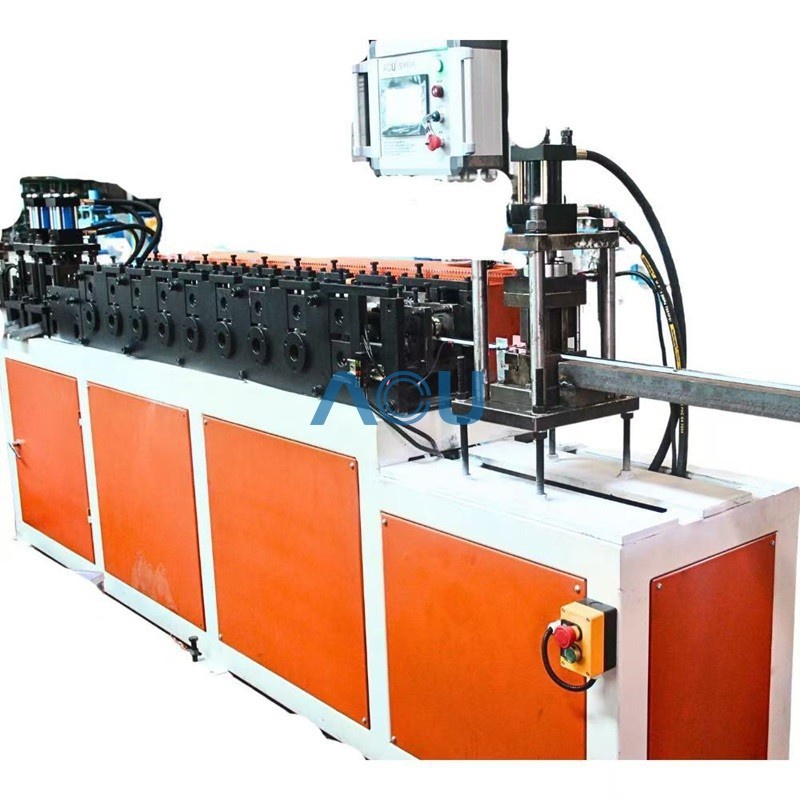
A roll forming machine is a Roll Forming Machine that shapes a long strip of sheet metal into a desired cross-section through a continuous cold bending process. You feed coiled steel into the machine, and it passes through a series of rollers that gradually form the metal. This differs from stamping or press braking. Those methods use a single hit to bend metal. Roll forming uses multiple sets of rollers to progressively alter the shape. The basic principle of roll forming is simple: each pair of rollers makes a small bending change. The roll forming process continues until the strip reaches the final profile.
The basic principle of roll forming relies on gradual deformation. A roll former does not force the metal into shape all at once. Instead, the roll former machine applies successive bends across many stations. This makes roll forming a unique metal forming process. The roll forming system handles thin sheet metal with consistent cross-sections. A sheet metal roll forming machine can produce uniform parts at high speed. The roll forming technology behind this is both efficient and precise.
Think of a pasta maker. You feed flat dough through rollers, and each pass flattens it a little more. Roll forming works the same way. The roller pairs in a roll former each make a small change. The metal moves continuously through the machine. Each station adds another bending step. The profile takes shape gradually across the line.
This gradual approach separates roll forming from press braking. Press braking is a one-hit metal forming process. It cannot handle very long parts or complex cross-sections easily. Roll forming handles both. The roll forming process uses coiled material directly. This reduces scrap and eliminates secondary joining operations. A roll former can also perform punching and notching in-line. The key processes in roll forming include feeding, bending, and cutting. Each step happens in sequence without stopping.
Roll forming machines process various thicknesses. Standard roll forming machines handle 0.2 mm to 8.0 mm. Light-gauge steel ranges from 0.2 mm to 1.2 mm. Medium-gauge steel ranges from 1.2 mm to 3.2 mm. Heavy-gauge steel ranges from 3.2 mm to 8.0 mm or more. Material choice also matters. Mild steel works from 0.3 mm to 6.0 mm. Stainless steel works from 0.5 mm to 3.0 mm. Aluminum works from 0.3 mm to 5.0 mm.
The table below compares roll forming with press braking.
|
Attribute |
Press Brake Forming |
Roll Forming |
|---|---|---|
|
Process nature |
One-hit bending |
Continuous forming using pairs of rollers |
|
Volume suitability |
Low- to medium-volume orders |
Long production runs of identical components |
|
Part size |
Limited by sheet size and bend length |
Handles long parts and complex cross-sections |
|
Cost-effectiveness |
Cost-effective under the right conditions |
Cost-effective for high volumes |
A Full Automatic Roll Forming Machine and a 2 in 1 Roll Forming Machine both use these principles. The profile stays consistent from start to finish. You get repeatable results with minimal waste.
The roll forming process follows a clear sequence. You load metal coils onto a decoiler, and the strip feeds into a straightener. The straightener removes coil set and pre-existing defects. Next, the strip moves into the roll former. Each pair of rollers adds a small bend. The strip passes through a series of rollers until the profile is complete. A straightener then removes any bends created during forming. Finally, a cut-off press cuts the product to length, and a run-out table collects the finished parts.
Here is the step-by-step workflow:
Load the metal coil onto the decoiler.
Unwind the coil so the strip feeds into the straightener.
Straighten the strip to remove coil-set and defects.
Feed and guide the strip into the pre-punch press, or directly into the roll forming machine.
Pass the strip through successive pairs of forming rolls, each adding a gradual bend until the profile is complete.
Run the formed profile through a straightener to remove bends from forming.
Cut the product to length at the cut-off press and stack it on a run-out table.
The process runs continuously. A Full Automatic Roll Forming Machine keeps production steady without stops. In-line punches and notches handle holes and slots before cutting. A flying cutoff press cuts the part to length while the line keeps moving.
Roll stands form the heart of any roll former. Each stand holds a pair of rollers that bend the strip in small increments. A typical line uses many stations. Each station adds one controlled bend. The metal undergoes progressive plastic deformation across these rolling stations. Material thickness does not change significantly during this process.
The number of stations depends on profile complexity. Simple profiles need fewer stations. Complex profiles need more. A 2 in 1 Roll Forming Machine combines functions to save floor space. Production speed varies by machine type. Heavy gauge roll forming runs 1 to 10 meters per minute. Standard industrial roll forming runs 10 to 30 meters per minute. High-speed roll forming reaches 30 to 60 meters per minute. Ultra high-speed roll forming exceeds 60 meters per minute. The key processes in roll forming — feeding, bending, and cutting — all depend on proper station design. A well-designed Roll Forming Machine delivers consistent profiles at high production rates.
The decoiler holds and unwinds steel coils. You can choose from several capacities: 3 ton, 5 ton, 10 ton, 15 ton, or 20 ton decoilers. Hydraulic or motorized decoilers with 2-3 ton capacity also exist. The decoiler feeds the strip into the roll forming system.
The feed system guides the strip into the first roll stand. A tension stand roller maintains controlled strip tension between process sections. This roller ensures stable strip tracking and reduces flutter. Proper installation requires parallel alignment to the strip path, correct elevation, secure mounting, smooth rotation verification, and proper spacing between rollers. Incorrect positioning alters the tension profile.
The drive system powers the rollers. You can select from four main types:
|
Drive System |
Power Source |
Key Characteristics |
|---|---|---|
|
Mechanical Drive |
Gears, chains, and belts |
Low cost, easy to apply, less efficient, noisy |
|
Hydraulic Drive |
Fluid power |
Greater power, precise control, complex and expensive |
|
Electric Drive |
Electric motor |
Clean and quiet, requires accurate control mapping |
|
Servo Drive |
Electronic controls |
Most advanced, high accuracy and flexibility |
The control system manages speed, alignment, and cut-off length. PLCs process sensor inputs and encoder feedback. Encoders measure strip movement and line speed. VFDs control motor speed and torque. Industrial communication networks like EtherCAT and Profinet enable real-time synchronization. Poor integration causes synchronization drift and cumulative length error, especially at high line speeds.
Companies like FOSHAN ACU specialize in manufacturing these key components of a roll forming machine for high-volume production.
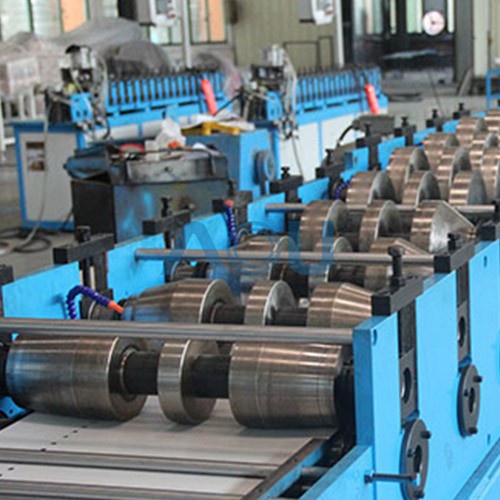
Roll forming delivers several distinct advantages for high-volume production. You minimize waste, and this efficiency makes roll forming cost-effective for long production runs. It produces uniform cross-sections with absolute geometric repeatability. Since rollers remain fixed, the first profile matches the last profile across the entire production cycle. This enables high production speeds.
You hold tight tolerances through every stage for your profile:
|
Tolerance Category |
Standard Value |
|---|---|
|
Linear dimensions (between bends) |
±0.030 inches |
|
Angular tolerances on bends |
±2° |
|
Bow and camber |
<0.040 inches per 40 inches |
|
Twist |
<0.120 inches per 40 inches |
These tolerances ensure each profile meets performance requirements consistently. The roll former maintains tight tolerances throughout the production cycle. Every profile achieves the same high quality across the entire production run.
Your roll former can integrate punching and cutting in-line. The roll forming process supports high speeds, with standard industrial lines running 10 to 30 meters per minute. Each roll former station adds a gradual bend, ensuring repeatable production results. This makes roll forming ideal for consistent production across large volumes.
Construction applications of roll forming machine include roofing panels, wall panels, and metal decking. Steel door frames use roll forming with a flying cutoff for high-speed cuts. Structural Z- and C-channel profiles for steel buildings depend on roll forming for tight tolerances. Metal studs require controlled camber so parts snap into track systems. Each profile in construction serves a specific purpose. Structural profiles support heavy loads in building frameworks.
Automotive applications of roll forming machine include frames, bumpers, and structural components. Pickup truck bed reinforcements need dedicated roll tooling. A roll former handles reinforcement beam designs for different vehicle models. Each profile must fit precisely within the vehicle body structure. Automotive profiles require tight dimensional control.
HVAC systems use roll forming to produce ductwork. Furniture manufacturers produce metal frames with roll forming technology. Common profiles include channels, C-sections, custom tubes, hat sections, Z-sections, angles, strut, T-sections, U-channels, and hemmed profiles. These profiles serve specific applications across multiple industries. Each profile offers unique structural benefits. Your profile meets tight specifications every time.
Companies like FOSHAN ACU provide roll forming solutions for all these industries.
A roll forming machine transforms flat metal coils into precise profiles. You feed the coil through a decoiler into roll stands. This roll forming operation delivers efficiency and consistency. The roll forming process serves construction, automotive, and HVAC industries. The roll forming method reduces waste and ensures repeatability. Companies like FOSHAN ACU specialize in this essential roll forming technology.
You can run mild steel, stainless steel, and aluminum. Thickness ranges vary by material. Mild steel handles 0.3 mm to 6.0 mm. Stainless steel handles 0.5 mm to 3.0 mm.
Speed depends on your line type. Standard industrial roll forming runs 10 to 30 meters per minute. High-speed roll forming reaches 30 to 60 meters per minute. Ultra high-speed roll forming exceeds 60 meters per minute.
Roll forming suits long production runs of identical parts. You get uniform cross-sections and tight tolerances. Press braking works better for low-volume orders. Roll forming reduces scrap and handles long parts with complex profiles.
 Signup our newsletter to get update information, news, insight or promotions.
 FOSHAN ACU IMP.&EXP.CO.,LTD.

 IPv6 network supported
Our hours
Mon 11/21 - Wed 11/23: 9 AM - 8 PM
Thu 11/24: closed - Happy Thanksgiving!
Fri 11/25: 8 AM - 10 PM
Sat 11/26 - Sun 11/27: 10 AM - 9 PM
(all hours are Eastern Time)
Hi! Click one of our members below to chat on