Sep 15, 2026
Pipe Making Machine: How Automation and Precision Improve Modern Pipe Production
The demand for efficient and consistent metal pipe production continues to shape the development of modern manufacturing equipment. For pipe manufacturers, HVAC suppliers, fluid-handling equipment producers, and other metalworking businesses, choosing the right pipe making machine can directly affect production efficiency, dimensional consistency, weld quality, and overall manufacturing workflow.
Modern pipe production is no longer simply about forming a flat metal strip into a round section. Depending on the application, the production process may involve decoiling, leveling, forming, welding, annealing, inspection, sizing, cutting, and other downstream operations. Integrating more of these processes into an automated production line can reduce manual intervention and make production more repeatable.
This is particularly important for manufacturers working with different materials and applications. Thin galvanized steel used for furnace or HVAC-related applications requires precise forming and feeding, while stainless steel pipes for fluid applications place greater emphasis on weld quality, surface condition, pressure endurance, and inspection.
This article explains what to consider when selecting a pipe making machine and how different machine configurations can address different production requirements.
What Is a Pipe Making Machine?
A pipe making machine is industrial equipment used to transform metal strip, sheet, or coil material into finished pipe or tube products through a controlled sequence of forming and processing operations.
Depending on the machine design, a production line may include:
Decoiling or coil loading
Leveling
Material feeding
Roll forming
Seam welding
Weld flattening
Annealing
Online inspection
Straightening
Cutting
Final sizing
The exact configuration depends on the pipe material, diameter, wall thickness, application, and required production process.
For manufacturers, the key question is therefore not simply "which pipe making machine is the fastest?" Instead, it is whether the machine can provide the required combination of forming accuracy, production stability, welding quality, automation, and material compatibility.
Why Automation Matters in Pipe Manufacturing
Automation has become an important consideration for manufacturers looking to improve production consistency while controlling labor requirements.
A conventional production process may require operators to manually transfer material between multiple stages. Every additional manual operation introduces opportunities for inconsistent feeding, incorrect positioning, dimensional variation, or production delays.
An automated pipe production line can connect multiple processes into a more continuous workflow. For example, an automated stainless steel pipe production process may integrate:
Cradle loading → forming → welding → annealing → online inspection → sizing and cutting
When these operations are coordinated, manufacturers can reduce unnecessary handling and establish a more consistent production sequence.
Automation does not eliminate the need for skilled operators. Instead, it allows operators to focus more on machine monitoring, process control, quality inspection, tooling adjustments, and production management.
For companies producing pipes in relatively high volumes, this can be particularly valuable because even small inconsistencies can become significant when repeated across thousands of pieces.
What Should You Look for in a High-Precision Pipe Making Machine?
Not every pipe production application requires the same machine configuration. However, several technical factors are worth considering when evaluating equipment.
1. Material compatibility
The first consideration is the material being processed. Common pipe and tube materials include:
Stainless steel
Galvanized steel
Carbon steel
Other coated or specialty metal sheets
Material thickness also has a major influence on forming and welding requirements.
A machine designed for thin galvanized sheet should not automatically be assumed to be suitable for heavier stainless steel pipe production. The forming rollers, feeding system, welding process, power configuration, and overall machine structure need to match the intended material range.
2. Forming accuracy
Dimensional accuracy is essential when pipes need to connect with fittings, equipment, valves, ducts, or other components. Inaccurate forming can lead to:
Poor dimensional consistency
Difficult assembly
Uneven seams
Additional adjustment work
Higher scrap rates
Leveling is therefore an important stage in many automated production lines.
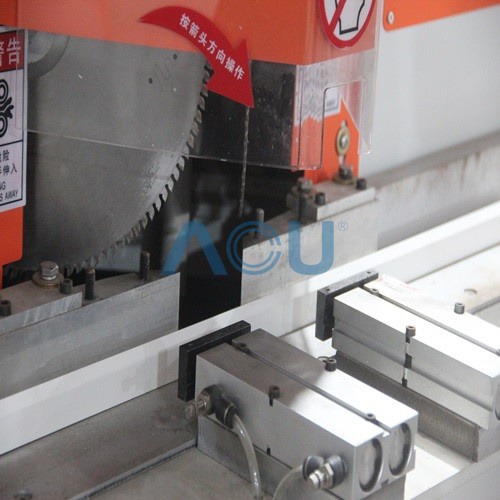
ACU's high precision automatic furnace pipe making machine is designed for processing 0.25 mm galvanized steel and incorporates a 9-roller leveling system before subsequent forming operations. The machine integrates decoiling, forming, embossing, rib pressing, and hydraulic shearing into the production process, with a stated length tolerance of ±0.5 mm.
This type of integrated configuration is particularly relevant for manufacturers producing thin galvanized pipe products where consistent feeding and forming are important.
3. Production workflow
A machine should be evaluated as part of the entire manufacturing workflow rather than as an isolated piece of equipment. For example, if a manufacturer currently uses separate machines for:
Coil loading
Leveling
Forming
Welding
Annealing
Inspection
Cutting
there may be opportunities to integrate some of these operations into a continuous line. The benefits can include reduced material handling, fewer intermediate storage points, and a more organized production process.
However, the optimal degree of automation depends on production volume, product variety, available floor space, labor costs, and investment budget.
High Precision Automatic Furnace Pipe Making Machine for Thin Galvanized Steel
Thin galvanized steel requires careful material handling because excessive deformation, poor feeding, or improper forming can affect the finished product.
The high precision automatic furnace pipe making machine from ACU is specifically designed for processing 0.25 mm galvanized steel. Its production process integrates several operations, including:
Decoiling
Leveling
Feeding
Forming
Embossing
Rib pressing
Hydraulic shearing
A 9-roller leveling system helps prepare the material before forming, while hydraulic shearing is used for cutting the finished product. The machine is therefore suited to production environments where manufacturers need a more integrated approach to processing thin galvanized material.
When is this type of machine a good fit?
It may be worth considering when the manufacturer needs to produce thin galvanized pipe products and wants to reduce the number of separate processing stages.
It can be especially relevant for applications where the production process includes additional operations such as rib pressing or embossing rather than simple tube forming alone.
The important point is that equipment should be selected according to the actual product structure. If the finished pipe requires additional forming features, integrating these operations into the production line can simplify the manufacturing workflow.
Stainless Steel Pipe Welding Machine for Fluid Applications
Stainless steel pipe production presents a different set of requirements. In fluid-handling applications, the pipe must not only have consistent dimensions but also provide a suitable welded seam and surface condition.
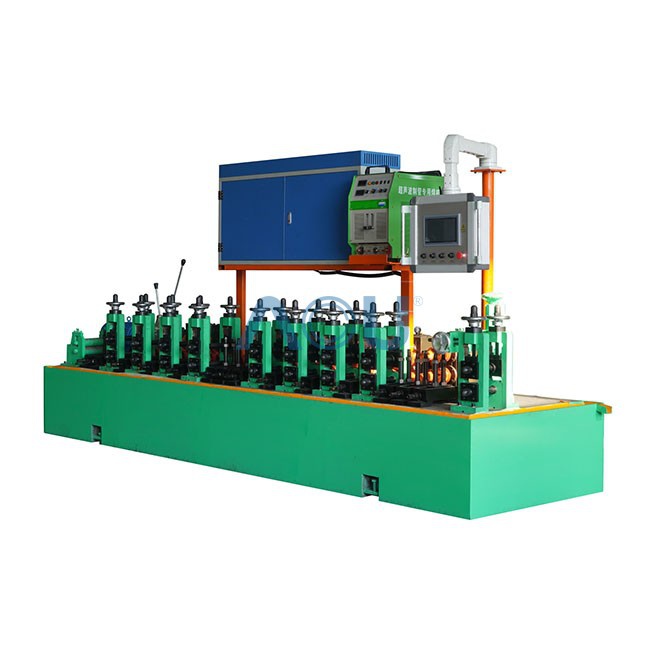
ACU's stainless steel pipe welding machine is designed specifically for fluid applications and incorporates several processes intended to improve production consistency. The machine features an internal weld flattening system and argon-protected bright annealing. According to ACU's product information, the process provides a smooth silver-white weld appearance while supporting the production of stainless steel pipes designed for fluid applications.
The production process includes:
Cradle loading → forming → welding → annealing → online inspection
The machine also incorporates online whirlpool inspection and overload protection.
These functions are particularly relevant when manufacturers need to combine welding, finishing, and inspection within a more automated production workflow.
Why Weld Quality Matters in Stainless Steel Pipe Manufacturing
For welded stainless steel pipes, the weld is an important part of the finished product. An improperly controlled weld can affect the pipe's:
Surface quality
Structural consistency
Internal flow characteristics
Corrosion resistance around the weld area
Suitability for the intended application
Internal weld flattening is therefore valuable in applications where a smoother internal surface is desirable. A smoother internal weld can help reduce unnecessary disruption to fluid flow and create a more uniform internal pipe surface.
The role of argon-protected bright annealing
Annealing is another important stage in stainless steel tube production. The ACU stainless steel pipe welding machine uses argon protection during bright annealing. The controlled atmosphere helps protect the material surface during the heat-treatment stage and contributes to the bright appearance of the finished weld area.
For manufacturers supplying stainless steel pipes for fluid-handling applications, the combination of welding, weld flattening, and controlled annealing can be more useful than evaluating the welding unit alone.
Pipe Making Machine vs. Pipe Welding Machine: What Is the Difference?
These terms are sometimes used interchangeably in search queries, but they do not always describe exactly the same equipment.
A pipe making machine generally refers to equipment or a production line that forms metal material into pipe or tube products. Depending on the configuration, it may include forming, welding, sizing, cutting, and other operations.
A pipe welding machine, on the other hand, emphasizes the welding stage of pipe production. For example, stainless steel welded pipe production typically involves forming a flat strip into a tubular shape and then joining the longitudinal seam.
This distinction matters when purchasing equipment because a buyer looking for a complete production line may require more than a welding unit.
A simple comparison
Requirement
Pipe Making Machine
Pipe Welding Machine
Primary function
Pipe forming and production
Pipe seam welding
Material preparation
May include decoiling and leveling
Depends on line configuration
Forming
Core process
Usually integrated before welding
Welding
May be included
Core process
Annealing
Application dependent
May be integrated
Inspection
May be integrated
Can include online inspection
Cutting
Often integrated
Can be included
Best suited for
Complete pipe production workflows
Welded pipe manufacturing
For buyers, the most important factor is the actual production process rather than the terminology used to describe the machine.
How to Choose Between Different Pipe Production Solutions
Before purchasing an industrial pipe making machine, manufacturers should define their production requirements.
Start with the material
Identify the exact material type and thickness. For example:
0.25 mm galvanized steel
Thin stainless steel
Medium-thickness stainless steel
Carbon steel
Other coated steel
Material selection affects the forming, welding, and finishing process.
Define the pipe dimensions
The required pipe diameter and wall thickness should be established before selecting equipment.
For stainless steel pipe production, ACU's YJ-series machine configurations cover different diameter and thickness ranges. The published models range from approximately 9.5–50.8 mm for the YJ40 to 114–219 mm for the YJ100, with corresponding thickness ranges depending on the model.
This illustrates why machine selection should be based on the actual product range rather than simply choosing the largest or fastest machine.
Consider production volume
A high-volume manufacturer may benefit more from a highly integrated automated line than a small workshop producing multiple low-volume products. Consider:
Expected daily output
Number of shifts
Product change frequency
Labor availability
Required automation level
Available floor space
Future production plans
A machine should ideally meet current requirements without making future expansion unnecessarily difficult.
Evaluate inspection requirements
Quality control should be considered during machine selection rather than added as an afterthought. Online inspection can help manufacturers identify potential problems earlier in the production process.
For stainless steel pipe manufacturing, ACU's machine incorporates online whirlpool inspection as part of its production configuration.
The specific inspection method required, however, should always be determined according to the pipe's intended application and applicable quality requirements.
Current Trends in Pipe Manufacturing
The steel market is showing signs of gradual stabilization after several challenging years.
According to the World Steel Association's April 2026 outlook, global steel demand is forecast to grow modestly in 2026 and accelerate in 2027. The association also expects developed markets including the United States and European Union to return to growth, while India remains one of the strongest major-market growth drivers.
At the same time, global trade in steel tubes and fittings remains substantial. World Steel in Figures 2026 reports approximately 39.9 million tonnes of steel tubes and fittings exports in 2025.
For pipe manufacturers, this environment reinforces the importance of maintaining competitive production costs and consistent product quality. The trend is therefore not simply toward "more automation." Instead, manufacturers are looking for automation that addresses specific production challenges:
Reducing unnecessary manual handling
Improving dimensional consistency
Maintaining stable welding quality
Integrating inspection into production
Reducing process interruptions
Supporting multiple product specifications
Improving overall production visibility
This is where a properly configured pipe production line can provide practical value.
Common Questions About Pipe Making Machines
What is the best pipe making machine for stainless steel?
There is no single machine that is best for every stainless steel pipe manufacturer. The correct choice depends on pipe diameter, wall thickness, production volume, welding requirements, finishing requirements, and the intended application.
For fluid-handling applications, a stainless steel pipe welding machine with integrated forming, welding, annealing, and inspection can be worth considering.
Can a pipe making machine process galvanized steel?
Yes, depending on the machine configuration and material specifications. ACU's high precision automatic furnace pipe making machine is specifically designed for 0.25 mm galvanized steel and integrates leveling, forming, embossing, rib pressing, and hydraulic shearing.
What is important when buying an automatic pipe welding machine?
Buyers should evaluate material compatibility, pipe diameter, wall thickness, welding technology, weld finishing, annealing, inspection, cutting, automation level, and ease of dimension adjustment.
Why is internal weld flattening important?
Internal weld flattening can create a smoother internal surface at the welded seam. This can be particularly useful for pipes used in fluid-handling applications where internal surface condition and flow characteristics are important.
Should I buy a complete pipe production line or individual machines?
The decision depends on production volume, product range, available labor, floor space, and investment plans. A more integrated line can reduce manual handling, while individual machines may provide greater flexibility for smaller or more varied production operations.
A Better Way to Evaluate Your Next Pipe Making Machine
Choosing a pipe making machine should start with the product rather than the machine. Before requesting a quotation, prepare information about:
Material type
Material thickness
Pipe diameter range
Finished pipe length
Required production volume
Forming requirements
Welding requirements
Surface and weld requirements
Inspection requirements
Desired level of automation
The more clearly these requirements are defined, the easier it is for a machinery supplier to recommend a suitable configuration.
For manufacturers producing galvanized pipe, the forming and leveling process may be the main priority. For stainless steel fluid pipes, welding quality, weld flattening, annealing, inspection, and pressure-related requirements may carry greater importance.
Build a More Efficient Pipe Production Process with ACU
Modern pipe manufacturing requires more than forming metal into a tube. Manufacturers need production equipment that matches their material, dimensions, application, quality requirements, and desired level of automation.
ACU provides pipe manufacturing equipment as part of its broader machinery portfolio, including solutions for pipe forming and stainless steel pipe welding.
If you are evaluating an automatic pipe making machine, upgrading an existing pipe production line, ACU can help you assess the appropriate equipment configuration based on your material, dimensions, and production requirements.
Explore ACU's pipe manufacturing solutions and contact the team to discuss your application, product specifications, and production goals.
Read More


 Signup our newsletter to get update information, news, insight or promotions.
 FOSHAN ACU IMP.&EXP.CO.,LTD.

 IPv6 network supported